
Ellis Long · 14 October 2026
Decoding Query Optimization Techniques That Sustain Visibility During Professional Directory Expansions
Professional directories handle expanding volumes of listings and user searches each year, and query optimization techniques play a central role in keeping those systems responsive while preserving visibility in search results. Observers note that effective indexing strategies reduce lookup times as record counts climb into the millions, and data from the Government of Canada innovation reports shows measurable gains in retrieval speed when composite indexes align with common search patterns. Those who've studied large-scale directory growth find that query planners rewrite requests on the fly to favor covered indexes, which cuts disk I/O and keeps page-load metrics within thresholds that search engines reward.
Core Techniques Behind Sustained Performance
Partitioning tables by geographic region or industry vertical spreads workload across storage nodes, and this approach prevents single-table scans from dominating CPU cycles during peak query traffic. Researchers at the University of Toronto documented how range partitioning on date-stamped records improved throughput by factors of three to five in simulated directory expansions completed before October 2026. Caching layers placed in front of the database store results for frequent queries such as location-based lookups, and cache invalidation rules tied to update timestamps prevent stale data from surfacing. Query rewriting engines detect subqueries that can be flattened into joins, and execution plans then choose hash joins over nested loops when row counts exceed certain thresholds.
Statistics collection routines run at regular intervals to keep cardinality estimates accurate, because outdated statistics lead the optimizer to select inefficient join orders. Administrators configure cost-model parameters so that the planner accounts for network latency between shards, and those adjustments prove especially useful when directories add new regional servers. Parallel execution frameworks split large aggregation queries across multiple cores, while result-set streaming delivers partial answers to clients before full computation finishes.
Monitoring and Adjustment During Growth Phases
Telemetry dashboards track query latency percentiles alongside directory record counts, and alerts trigger when median response times exceed service-level targets. Teams review slow-query logs weekly to identify statements that would benefit from additional indexes or materialized views. One study revealed that introducing covering indexes on name and category columns reduced average query duration from 180 milliseconds to under 40 milliseconds after a directory doubled its listings. Execution-plan diffs captured before and after index additions provide concrete evidence of plan stability, and version-controlled schema changes allow rollback if visibility metrics dip.
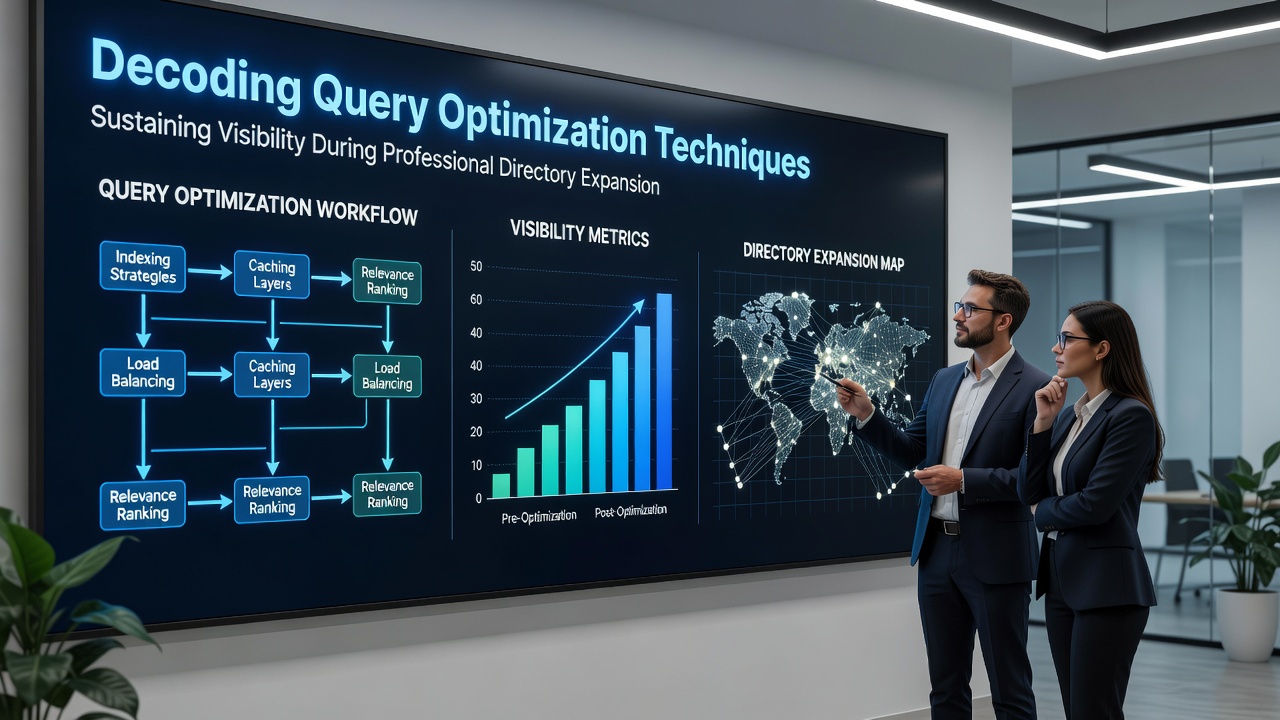
Load balancers distribute read replicas according to current connection counts, and connection pooling limits the number of simultaneous sessions that reach the primary node. Observers note that these pools reduce context-switching overhead and help maintain consistent latency even as concurrent users increase. Parameter sniffing mitigation techniques such as forced parameterization or plan guides keep execution plans from swinging wildly when literal values change, and this stability matters when directories serve both internal staff searches and public API calls.
Integration with Search Visibility Requirements
Search engine crawlers favor sites whose pages load quickly, and database response times directly influence those metrics. Directory operators therefore embed structured data markup generated from optimized queries so that rich snippets appear promptly in external results. Figures from the European Commission digital economy reports indicate that sites maintaining sub-second backend responses retained higher click-through rates after infrastructure expansions. Batch processing of non-critical updates during off-peak hours prevents write locks from interfering with read-heavy query workloads that feed public listings.
Materialized views refreshed on schedules derived from update frequency patterns deliver pre-computed aggregates for common dashboard reports, and this pre-computation frees the optimizer from recalculating sums and counts on every request. Those who've examined recovery after directory mergers find that re-analyzing tables immediately after bulk imports restores accurate row estimates and prevents temporary slowdowns that could affect indexed page rankings.
Conclusion
Query optimization in expanding professional directories combines indexing, partitioning, caching, and plan management to keep retrieval times low and search visibility intact. Data indicates that organizations applying these methods in coordinated sequences experience fewer ranking fluctuations during growth periods. Continued monitoring and incremental adjustments ensure the techniques scale alongside directory size, supporting both internal operations and external discoverability through October 2026 and beyond.